

By Omony Denis
In the fertile fields of Nwoya District, a quiet shift in farming practice is taking root as one that is reshaping how farmers prepare their land while safeguarding the soil for future generations.
For years, mechanization has been embraced as a relief from the laborious hand hoe. Today, more than 300 four-wheel tractors operate across the district, according to the Nwoya District Production Department. But while they have boosted productivity, scientists warn of an overlooked consequence: soil degradation caused by repeated compaction.
Research published in The Journal of Terramechanics has long highlighted that heavy agricultural machinery can compress soil, reducing its ability to absorb water, support root growth and the maintenance of fertility, an issue now becoming visible in parts of Nwoya where intensive tractor use has expanded rapidly over the past decade.
It is against this backdrop that a new innovation is gaining attention as walking tractors, technically known as fly tractors.
In 2025, Shalom Ventures (U) Limited, in partnership with the Climate Smart Jobs (CSJ) programme, introduced two-wheel walking tractors to smallholder farmers in Nwoya as an alternative to heavy machinery.
According to Charles Kaaya, the Chief Executive Officer of Shalom Ventures, the initiative was designed to address both environmental concerns and limited access to mechanization among small-scale farmers.
“When the CSJ programme came, we partnered with them to respond to areas where tractors had become a problem. How do we solve issues of pollution and access to machinery for smallholder farmers?” Kaaya explained.
Through the partnership, farmers are able to acquire walking tractors at about 22 million shillings, far cheaper than four-wheel tractors which cost more than 120 Million shillings a piece, alongside free training on operations and maintenance.
Kaaya noted that the company subcontracted Wash & Wills Agricultural Mechanization to promote low-horsepower machines of under 50 horsepower, which are considered less damaging to the soil and more environmentally friendly. The tractors run on two wheels with gear control panels fitted to the handles, looking moreless like wheelbarrow push handles. Its acceleration and brake systems sit on the right handle with turn leavers on both sides.
The farmer, wearing a safety gumboot, walks behind the engine as he plows the pre-cleared field. “The demand has increased drastically because farmers can now afford mechanization that is also easier to operate,” he said.

Caption; Charles Kaaya, the Chief Executive Officer of Shalom Ventures (Photo by Omony Denis)
Gender Dimension
The programme has also placed strong emphasis on inclusion, particularly encouraging women to take part in agricultural mechanization.
“We aimed to increase the number of operators and especially women. Over 70 percent of our staff are female,” Kaaya added.
Among the early beneficiaries is the Waribu Cing Farmers Group in Adilang Village, Purongo Sub-county.
The group’s chairperson, Akello Irene, says the introduction of walking tractors has significantly reduced production costs.
“Previously, we hired four-wheel tractors at about 100,000 shillings per acre. With our own walking tractor, the cost has dropped to around 70,000 shillings,” she said.
Beyond cost savings, Akello says members are cultivating more land than before.
“I used to cultivate only four acres using hired tractors, but with the walking tractor, I can manage at least six acres per season,” she added.
For farmer Okello Francis, who first accessed the technology through a group before purchasing two walking tractors of his own, the benefits go beyond affordability.
Okello says the machines allow him to farm more sustainably while maintaining soil health.
“The soil remains in better condition compared to when heavy tractors were used. We are seeing better production results,” Okello said.
He explained that, unlike four-wheel tractors, walking tractors allow shallow tilling, which reduces erosion and protects topsoil.
“One cannot get beyond ten bags per acre without fertilizer when using heavy tractors. But with walking tractors, soil erosion is minimized, and yields are more stable,” he added.
For Akanyo Mercy, a farmer and tractor operator, switching from four-wheel tractors to walking tractors was both a practical and health decision she made.
“I previously used a four-wheel tractor, but it caused fatigue due to excessive vibration. I switched to a walking tractor because it is easier to control and gentler on the soil,” she said.
Akanyo grows soybeans, maize, and groundnuts and has used the machine for over a year.
However, she notes that the two-wheel tractor design still presents challenges, particularly the lack of a seat.
“Operators walk behind the machine the entire day, which is exhausting. Adding a seat would increase comfort and productivity, allowing farmers to cultivate up to one acre or more per day,” she suggested.
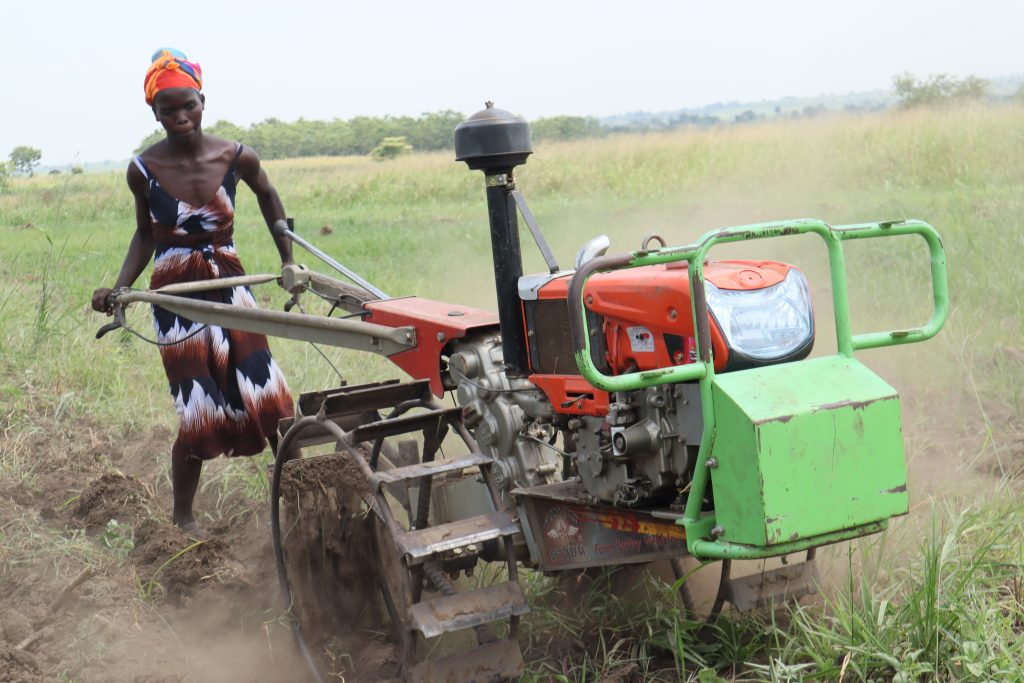
Caption; Akanyo Mercy, one of the beneficiaries operating her hand tractor in Adilang village (Photo by Omony Denis)
Dr. Ebong Tamim, Nwoya District Production Officer, describes walking tractors as a climate-smart innovation that protects soil structure while improving efficiency.
“The machine allows adjustment of blade depth and mostly works on topsoil, which helps conserve soil structure,” he explained.
He added that the machines are also less destructive to farm access paths and vegetation.
“Unlike four-wheel tractors, walking tractors do not require clearing entire gardens. Farmers can work while preserving crop cover and young plants,” he said.
According to district records, Nwoya has received 11 walking tractors from the Ministry of Agriculture, Animal Industry and Fisheries (MAAIF), four under the PRELNOR programme, and five from the Uganda Wildlife Authority since December 2023 to date.
The Ministry of Agriculture says walking tractors were first introduced under the National Agricultural Advisory Services (NAADS) programme over a decade ago and have since gained momentum.
Beyond land preparation, the machines can be used for ridge making, spraying, irrigation pumping, and transport of produce during harvests and beyond.
Assistant Commissioner for Communication at the ministry, Acayo Connie, says the technology is key to improving land productivity while reducing labor burdens.
“With walking tractors, a farmer can open up to four acres a day. This improves land use, boosts production, and enhances household income and food security,” she said.
Acayo believes that the small horsepower tractors should also help reduce the challenge of labor that has often affected local farmers in Nwoya.
“So these walk-behind tractors are very compatible for small-scale farmers. You can imagine spending time in an acre. How many days or weeks will it take you to complete an acre?” says Mrs. Acayo
As more farmers adopt the technology, Nwoya is quietly positioning itself as a model for climate-smart agriculture in northern Uganda, where productivity and environmental protection are no longer competing goals, but shared priorities.This story was sponsored by Smart Climate Job in partnership with Infonile