

Bt Tolit Ivan
In Atiak Sub County, northern Uganda, the climate is changing faster than expected. Rainfall has become less predictable for farmers in households without irrigation technologies to grow adequate foods all year round.
Longer dry spells and extreme weather are making farming more difficult for many families there. Yet amid these challenges, one animal is helping households adapt and build resilience – the Savannah grassland goat also known as the Mubende Goats.
“The seasonal rainfall pattern here is no longer the same with what our forefathers knew. Sometimes we plant our crops expecting rain, but it doesn’t come or appears too late for timely planting. Other times the rains are too heavy and destroy our crops with water logging or floods.” Charles Ayella, the chairperson of Benaaps Business Solution Limited said during a recent interview.
War Driven Economic Collapse
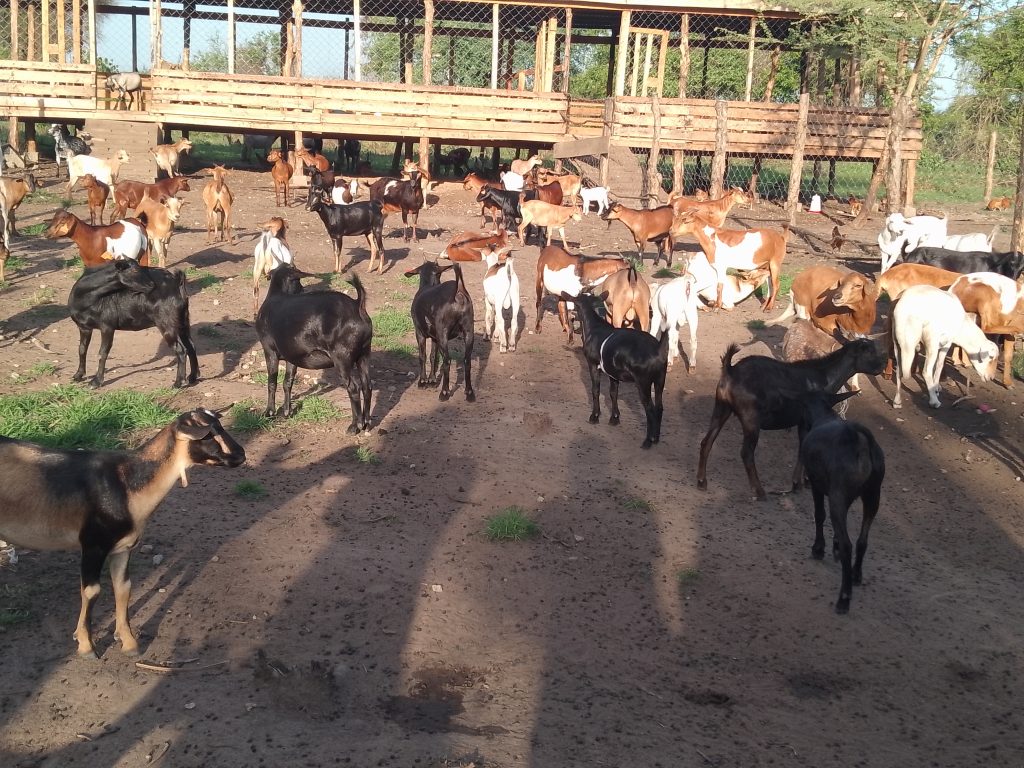
The group is located about 70 kilometers from Gulu City in Amuru district in the less known Lukulia Village in Atiak Town Council. Scars of the 1995 Atiak Massacre by the Lord’s Resistance Army rebels are still fresh for many of its nine members. Up to seven are women of advanced ages. They look after 44 goats, out of which 26 are the Mubende Savannah type while 18 are second generation hybrid goats, all acquired with financial support from Climate Smart Jobs.
Mega FM interviewed several members of the farmer Group Enterprise who indicated that for generations, crop farming has been the backbone of livelihoods in Atiak Sub County. And that several crops performed well including traditional staple foods – rice, cassava, millets, Simsim as well as beans and Maize.
By 1995, the rebel Lord’s Resistance Army rebel was still active in Atiak sub county area, like any other parts of Northern Uganda carrying out atrocities which displaced residents to live in military protected camps for internally displaced persons (IDP). On April 20th, 1995, about 300 rebel fighters attacked Atiak IDP camp under the leadership of second in command of the group, Vincent Otti, himself a son of Atiak, and brutally massacred an estimated 250 people – majority of whom were economic pillars of their households. Mourning this sudden economic loss has been slow and painful in the sub county resulting. Frustrations built among residents with changing weather patterns – including appearances of floods, prolong dry spells and short rainfall periods and acute loss of soil fertility.
All the while, the residents believed it was the ghosts of the killed during the massacre haunting their land to avenge the atrocities as they waited for many years for the International Criminal Court (ICC) to bring Vincent Otti to justice.
To date, Otti remains unseen, believed to have been killed by his boss, Joseph Kony, the elusive fugitive leader of the Lord’s Resistance Army (LRA) – himself indicted by The Hague based Court.
The changing weather patterns and reliance on homemade seeds kept on gradually reducing the agriculture productivity potential of the once food basket overtime as farmers lacked sustainable access to improved seeds. More economic frustrations-built livelihoods uncertainty in the area as farmers could not self-innovate to adapt to the fast-changing climate change over the last two decades.
Small networks of farmers began looking for practical ways to protect both their food security and their incomes through different enterprises including rearing small, bodied Mubende Savannah goats.
Alal Beatrice, an elderly member of the group, has spent the last five years of her life rearing such local goats but earned very little profits from the business due to poor quality of the livestock and low production. Instead of practicing free range system, population pressure on the land restricted her farming to tethering her goats. On days she was too tired to return the animals home, they endured long cold nights and hot days outside in the cold during rainy days and nights.
“My business soon got attacked by frequent incidents of diseases and pests. The goats’ numbers were on decline rather than increase. Abortion was commonplace as water sources dried up.” Alal vividly described her situation, adding that she sold off some goats to pay village court fines after her goats strayed and grazed on her neighbors’ crop fields. Peace remained perpetually distant. Household poverty increased as trade became nearly impossible despite high demands for goats for cultural and social needs.
Alal’s business faced several challenges including lack of capital for expansion, poor breeding methods, low immunity and lack of knowledge amongst others.
Preventive Livestock Healthcare
Preventive livestock healthcare aims to keep the farmers’ animals as healthy and productive as possible amidst changing climates. The strategy of prevention is better than curing aims at stopping productivity problems before they happen among herds.
Lincoln Nyakudanga, a livestock consultant with Climate Smart Jobs specializing in goats breeding in Northern Uganda says, “prevention livestock healthcare includes all the practical steps that a farmer can take to stop infectious diseases (illnesses that can be spread from one animal to another) from affecting his or her livestock.” This includes using vaccines to stop or reduce the effects of diseases such as diarrhea, viral diseases, goat pox, contagious ecthyma and viral pneumonia as well as bacterial diseases like tetanus, brucellosis, mastitis and metritis. Others are foot and mouth disease, lumpy skin disease and mycotic diseases such as dermatophytosis and rickettsial infections like conjunctivitis – which are common causes of goat’s mortality in Uganda’s rural areas.
According to Nyakudanga, preventive healthcare also involves treating internal parasites (worms) and external parasites (such as ticks) effectively as parasites can become resistant to veterinary drugs. Hygiene, proper grazing management, watering and proper care of kids are integral parts of preventive.
“Preventive healthcare also involves taking biosecurity measures. These are actions that reduce the risk that animals will catch infectious diseases and include managing contact between farmers’ animals and restricting the number of visitors to breeding areas where livestock are kept. Otherwise, applications of recommended disinfectants such as foot dips must apply,” the livestock expert advised.
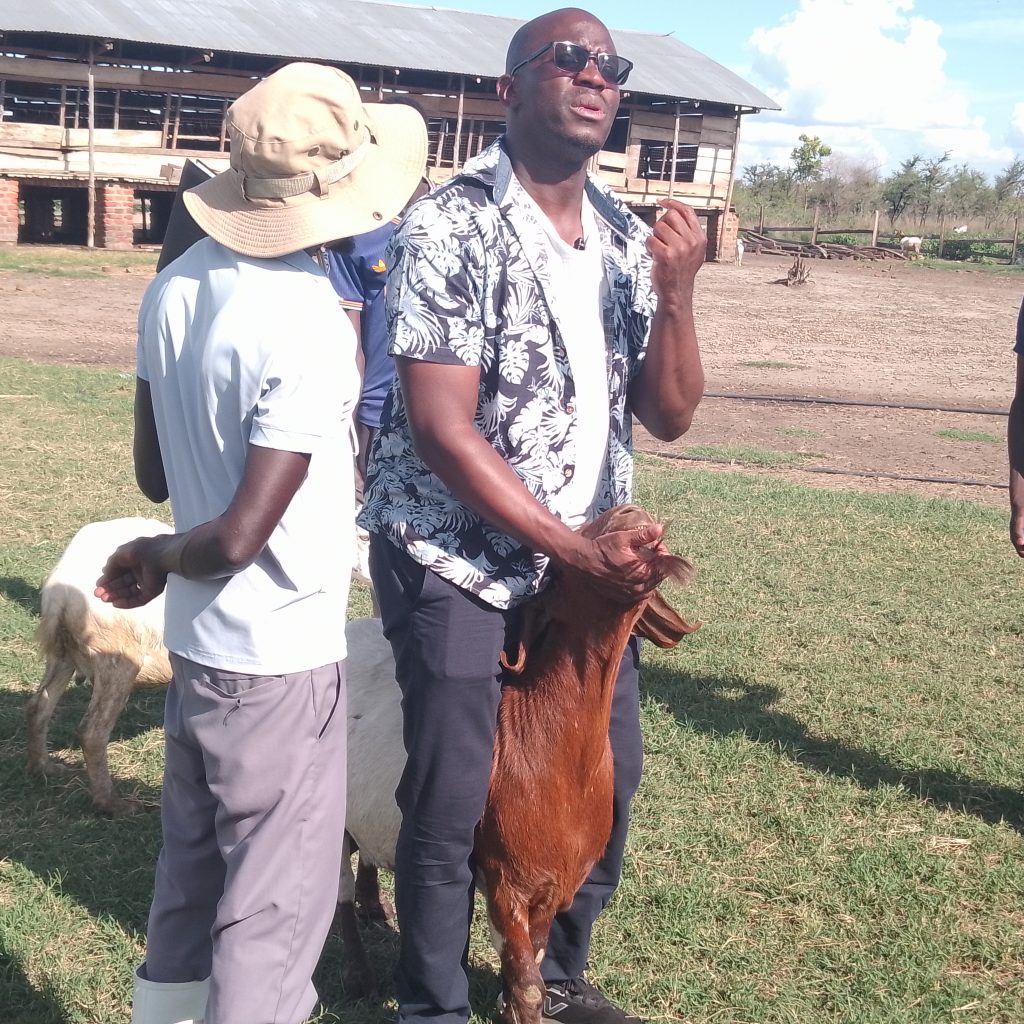
Preventive healthcare goes beyond the above direct steps to prevent diseases. It also involves taking actions to ensure that livestock are as healthy and productive as possible, such as improving nutrition and housing, managing the reproduction and the way they breed. This can be achieved by choosing the right breeds for a farmers’ situation and managing the intervals between each birth while dealing with infertility problems among the herds. Properly managed reproduction can have a big impact on productivity.
From Training to Practice
By 2025, Climate Smart Jobs introduced such measures to members of Bennaps Farmer Group Enterprise in view of building their resilience to Climate Change and combating household poverty. A reproduction compliance raised shelter sitting inside a perimeter wire mess fence was constructed for the group before they were supported to procure hybrid variety.
Group members received training in preventive healthcare and agribusiness skills. They were oriented to best practices such as making and keeping a business plan of action, a document detailing the steps livestock keepers must take to prevent disease and improve the health of their animals and when those steps can be taken at the exact most time of need.
Charles Ayella, the group’s chairperson, told Mega FM that their training emphasized the fact that “preventive livestock healthcare measures like vaccination minimize animal deaths and serious diseases during outbreaks because sick animals can infect both people through contact or consumption of their meat and other livestock when they share grazing and breeding spaces.”
Today, the group can effectively quarantine sick goats as they have been equipped with four different multiple spacious and partitioned sections. There are also plenty of play areas behind the gated perimeter fence for both kids and adults. The group’s main goal now is to prevent these livestock from getting sick, and to help increase the farm productivity before they can sell and earn income.
So far, mortality and abortion among the herd have reduced, the preliminary signs of hopes according to Alal.
Goat breeding promises to be one of the most climate-resilient practices rural small-holder farmers can engage in as goats can significantly survive on fairly any vegetation that many other animals cannot effectively utilize in the worst of a season. They also require relatively little space to rear, reproduce quickly, and provide families with multiple sources of value for farmers facing shortage of land. Meat for family nutrition. Manure to improve degraded soil fertility. And income during times of financial need.
According to Ayella, the chairperson of Benaaps Business Solution Limited, the support of Climate Smart Jobs has already opened the gateway to the billion-dollar South Sudan markets as buyers from across the border flock their breeding center for purchases already.
“We believe that we will sell a hybrid goat between 250,000 and 500,000 Uganda shillings for each due to the oncoming demands from South Sudan and neighboring districts such as Adjumani.” He stated.
Within Atiak Sub County and Northern Uganda in general, Mubende Savannah goats’ cost between 100,000 and 150,000 shillings for adults weighing between Seven and Nine kilograms. Due to poor feeding practice and quality, achieving such weights takes a long time.
Irene Amony, 45, a resident of Lukulia Cell in Atiak Town Council is another member of Benaaps Business Solution Limited. She is a teacher by profession. Joined the group to diversify her income and save for the future. During this media visit, she was the group member on duty to take the livestock out to graze and water. There is a plan to sink and install a solar driven borehole for the farmers following training on hay making and feed supplementation. The hay making machine is already part of the support to the group.
Veterinary Services
Government of Uganda set up Gulu University in Gulu City as an agriculture college to transform communities in the Northern Uganda region. Its faculty of Agriculture and Environment has trained so many veterinary service providers who are already providing extension services to farmer groups like Bennaps.
Dr. Collins Okello is an Associate Professor, Senior Lecturer and Dean of the Faculty of Agriculture and Environment at Gulu University. He told Mega FM that Climate Change phenomenon is no longer a distant threat for farmers in the region as several studies have indicated that the average temperature of the region rose by about 0.8 degree Celsius over the past three decades.
“To an ordinary farmer, the increment sounds negligible. To us environmental scientists, we understand that it is significant enough to destabilize the rainfall patterns of the region, especially when corelated with the massive forest destruction which happened in the region.” He explained.
Indeed, the region’s protective natural forests – majority of which grew on private land were decimated for Charcoal production as displaced persons retreated home from the camps for internally displaced persons. Some were cleared for establishment of commercial farms. Exposed to climate vagaries, professionals like Dr. Okello are busy in the field training farmer group members to become veterinary paraprofessionals capable of providing basic emergency first aid to sick or injured livestock, spraying ticks and administration of dewormers as they wait for certified veterinary care givers to vaccinate their animals.
“We are training community members to first of all know how to read effective labels on dose medication for them to purchase medicine from a trader, how to qualify or disqualify its quality or whether the right dosage is administered.” Dr. Okello said during an interview with Mega FM from the Faculty of Agriculture and Environment.
If the dosage is too low, it may not be effective, and if it’s too high, it might be harmful/toxic to the livestock, humans and the environment in general. Farmers must therefore calculate the right dosage and apply it correctly for best treatment outcomes in their herds.
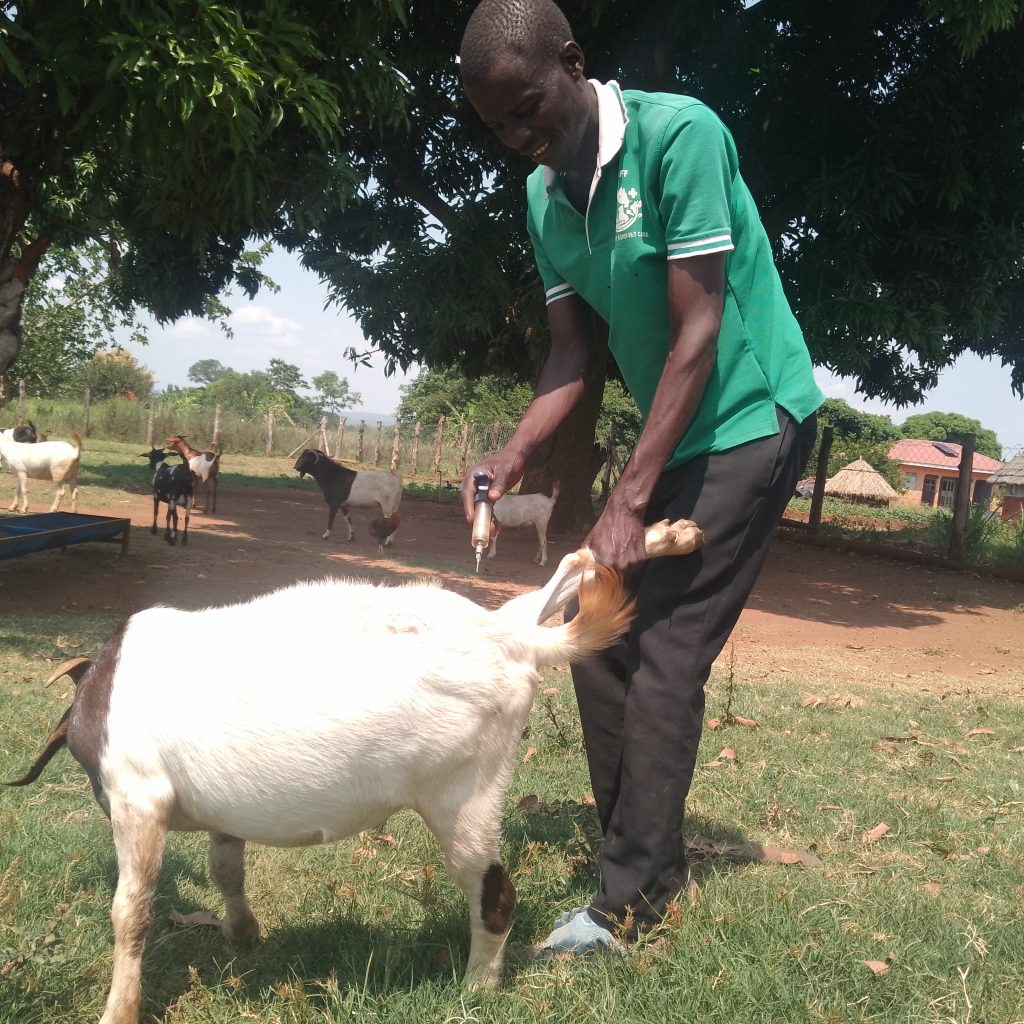
Uganda’s veterinary law available at the Ministry of Agriculture, Animal Industry and Fisheries restricts the sale of illegal veterinary medicines and ensures that veterinary products are stored correctly so that they remain effective. For example, many vaccines need to be kept cold even while being transported to the farms by Vet service providers.
When blended with regular on-the-farm visits, people who offer treatments and advice must physically observe animals, how they are being kept and provide more tailored and relevant livestock production advice than a pharmacist who simply sells veterinary drugs from a shop.
According to the Ministry of Agriculture, Uganda had an estimated 13.5 million goats by 2015, with about 95 percent being indigenous breeds. The ministry says improving genetics through selective breeding remains one of the most effective ways of increasing productivity and household incomes.
The East African country earns over US$ 4.1 million (approx. UGX 15.7 billion) annually from live goat exports, while goat meat (chevron) exports add roughly US$ 11,000. The broader live animal export sector (including cattle, sheep, and pigs) generates approximately US$ 43.5 million per year.
Lessons from Bennaps Farm Solutions Limited indicate that women and men may carry out different but complementary livestock management activities; depending on traditional practices and social norms.
It is therefore clear that actively involving both men and women in matters related to providing animal health care ensures successful outcomes.
The Production of this story was supported by InfoNile in Partnership with Palladium under the Climate Smart Jobs.