

Mega & Agency
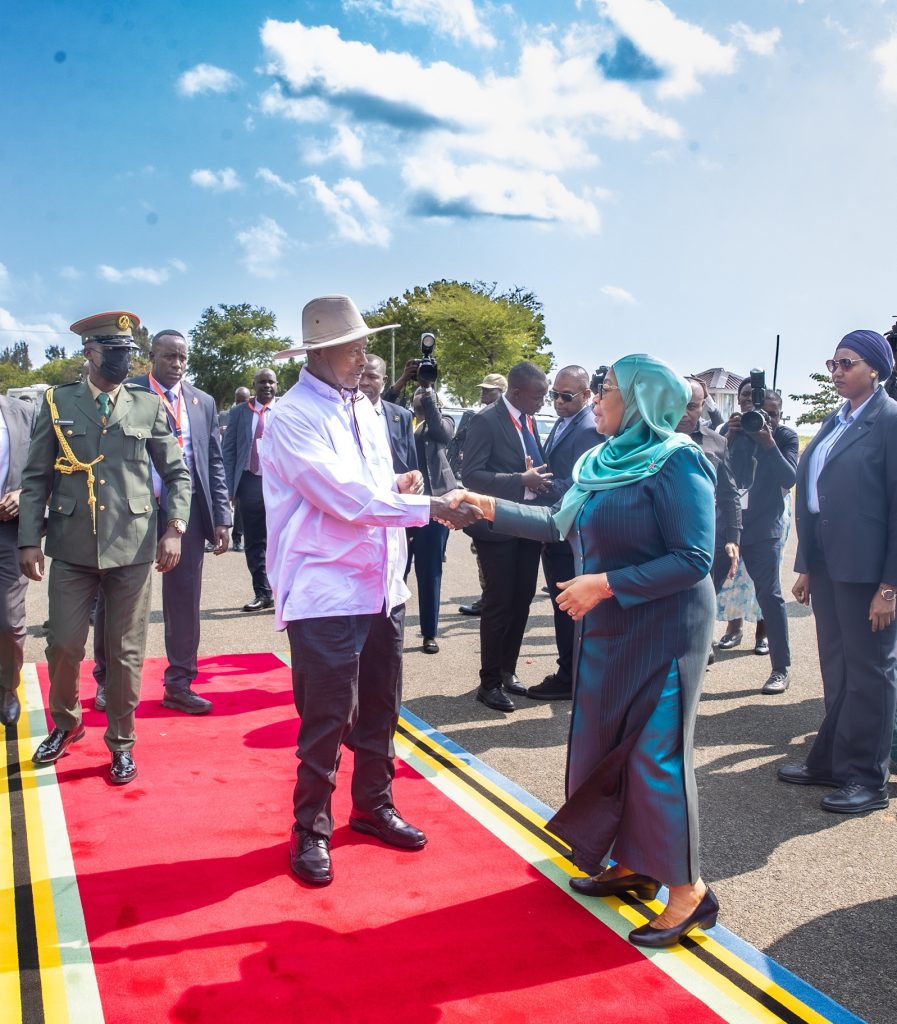
President Yoweri Museveni and Tanzanian President Samia Suluhu Hassan on Thursday commissioned a $30 million, Shs127 billion Double Q Automotive Assembly Plant in Nakirebe, Mpigi District, marking a concrete step in Uganda’s industrialisation drive and East African economic cooperation.
The launch, held on 19 November 2026 as the culmination of President Suluhu’s two-day state visit, centred on a 45-acre facility that assembles Sinotruk heavy-duty trucks and represents brands including GMC and XCMG.
The plant has an annual assembly capacity of 4,000 trucks. Officials said it already contributes about 20 percent local value addition through body-building operations and directly employs more than 1,200 Ugandans.
President Museveni thanked Double Q and its Chinese partners for the investment and urged stronger linkages with Uganda’s emerging steel industry. “On behalf of Uganda, I want to thank you so much for investing in Uganda, to assemble trucks, and also to build local parts, and eventually link up with the local steel industry,” he said.
He pointed to the country’s iron ore deposits as a foundation for domestic steel production that could supply vehicle components, reduce import dependence and retain more value in the economy. Museveni framed the project within a broader regional logic.
Citing Uganda’s iron ore and Tanzania’s natural gas, he argued that complementary resources, rather than fragmented national approaches, would accelerate industrialisation.
“You find that Tanzania has got gas, Uganda has got iron ore, and other products. So, when you put them together, instead of using them in a fragmented way, you will do better business,” he said.
He identified natural resources, production, markets and communication as pillars of transformation and called for a larger African market: “This is not just music,” he said. “It is showing the future. If you want to succeed, you need a united market for Africa.”
He also encouraged greater Chinese investment, noting Africa’s population of about 1.5 billion is projected to reach 2.5 billion in three decades, describing the continent as a future business centre.
President Suluhu described the plant as a milestone in Uganda’s industrialisation and congratulated the government on supporting domestic manufacturing, including Double Q and Kiira Motors. She said industrialisation is now a necessity for job creation, value addition, technology transfer, export growth and reduced reliance on imported finished goods.
“Let us turn from being consumers of imported goods to regional production and marketing hubs. We should aspire to manufacture, assemble, and produce,” she said.
She cautioned East African Community partners against uncoordinated competition in similar industries and urged complementary policies that strengthen regional value chains. Noting Sinotruk operations in both countries, she stated: “East Africa must compete with the world, not within itself.”
Double Q Managing Director Lin Yu outlined the company’s trajectory: operations began in Uganda in 2013 with construction materials transport, expanded into Sinotruk spare parts, after-sale services and leasing, and became the official distributor in 2017.
The company is developing training partnerships with Kyambogo University, Uganda Christian University and Nakawa Vocational Institute and supports the Buy Uganda, Build Uganda (BUBU) policy through local supplier engagement. Double Q already operates across Kenya, Tanzania, Rwanda, South Sudan, the Democratic Republic of Congo and Zambia.
Sinotruk International General Manager Song Yang thanked the Ugandan government for an enabling investment climate. He said Sinotruk serves customers in more than 160 countries, with overseas heavy-duty truck sales exceeding 1.2 million units, and projected global production and sales of more than 360,000 heavy-duty trucks in 2026, of which about 110,000 would go to African markets.
The plant represents one element of growing bilateral cooperation that also encompasses energy and transport infrastructure. Its long-term impact will depend on successful integration with local supply chains, consistent skills development and sustained regional market access.


