

Mega Fm & Agency
Uganda is expected to host the headquarters of the African Union Humanitarian Agency, with the institution’s establishment process scheduled to begin in December 2026 and take approximately three years before it becomes fully operational.
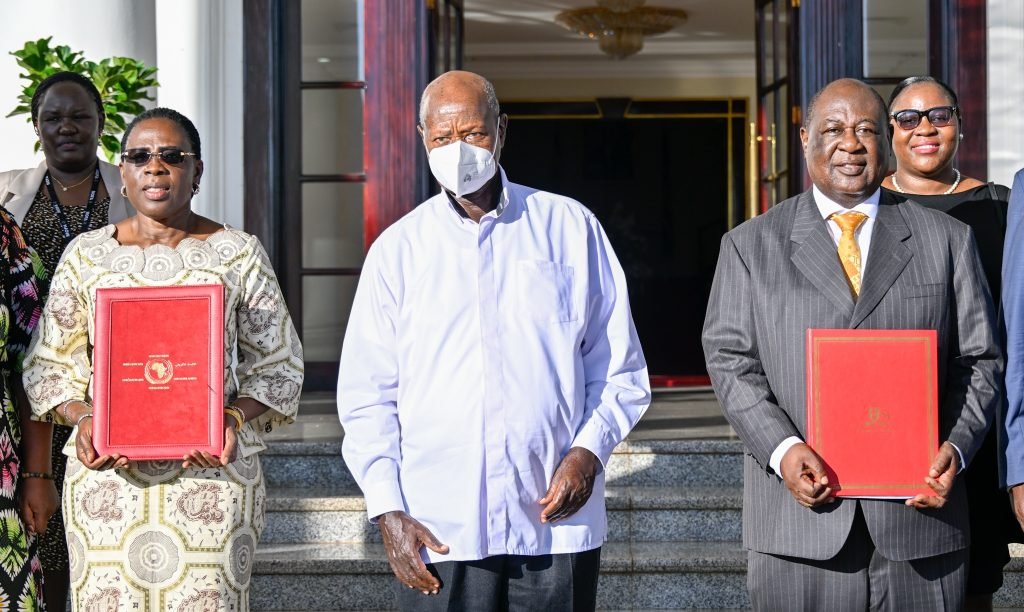
The development follows the signing of a Host Country Agreement between the Government of Uganda and the African Union at State House, Entebbe, on Monday, witnessed by President Yoweri Museveni. The agreement provides the legal and institutional framework for establishing and operating the continental agency in Uganda, which will coordinate humanitarian responses to emergencies, including armed conflicts, forced displacement, climate-related disasters and disease outbreaks.
Attorney General Sam Mayanja, who signed on behalf of the Ugandan government, said the country had secured the hosting rights after scoring 85 per cent in the competitive bidding process. He credited Museveni for spearheading Uganda’s efforts to secure the continental institution, saying the successful bid demonstrated the confidence and recognition Uganda enjoys within the African Union.
Mayanja said the government was committed to fulfilling its obligations under the agreement to facilitate the establishment and eventual operation of the agency. President Museveni welcomed the decision, saying the institution would strengthen Africa’s capacity to coordinate humanitarian assistance, particularly the distribution of food and other essential supplies to populations affected by emergencies.
The Minister of Relief, Disaster Preparedness and Refugees, Sam Engola, described the agreement as an important milestone in strengthening humanitarian cooperation among African countries. Engola said Uganda’s longstanding open-door refugee policy and experience in supporting displaced populations made it a suitable location for the agency.
African Union Commissioner for Health, Humanitarian Affairs and Social Development, Ambassador Amma Twum-Amoah, said the agreement represented more than a diplomatic undertaking, describing it as a step towards translating Africa’s political commitment into an operational humanitarian institution.
She said Uganda’s history of solidarity with displaced populations made it a fitting home for the agency, adding that Kampala’s association with the 2009 Kampala Convention further strengthened its significance. The Kampala Convention is the African Union’s continental legal framework for the protection and assistance of internally displaced persons.
Twum-Amoah said the agency was expected to provide a platform for coordinating African humanitarian interventions, strengthening institutional capacity and mobilising solidarity among member states. She cited armed conflicts, forced displacement, climate-related disasters, food insecurity and disease outbreaks among the growing humanitarian challenges affecting millions of people across the continent.
The commissioner disclosed that the African Union Commission had already mobilised the essential initial staff required to begin operationalising the agency. She said the commission was prepared to work with the Ugandan government to deploy the initial team to Kampala by the end of November or, at the latest, mid-December 2026.
Twum-Amoah emphasised that the priority was to move beyond institutional agreements and establish actual operational capacity, warning that Africa could not afford delays when millions of people needed timely humanitarian assistance. She said the agency should become an instrument of African solidarity, coordinated action and humanitarian diplomacy rather than remain an institution on paper.